Showing posts with label prc. Show all posts

Saturday, November 8, 2014

Blog mini - entry : Progress of Hong Kong Protests -- Mid - November 2014.

Select coverage (please read):

Yahoo! News - recent.

Article and another article from Guardian, U.K.

Recently from C.N.N. -- and more from C.N.N.

See here!  People of our mind subject to insidious ignominy of their authorities now day and night (pictures below).


Media Image


Media Image


Tuesday, August 12, 2014

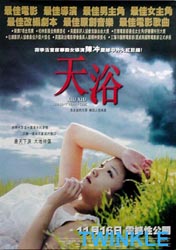
天浴 (1998). -- Without Sympathy.

Xiu Xiu – “The Sent – down Girl” (1998) -- More "Hong Kong" Cinema?

In Mandarin / English subtitles:  Every once in a while one sees a film like this that jars a few memories, of which those on the Cultural Revolution as seen by PRC leadership maybe thirty five years later and with a ten – year past remembrance of “Tian An.”  The Cultural Revolution in PRC and other Mao times showed the leadership goals and style of The Great Helmsman who given what his internal policies were, what with his re – education programs and the like in the mainland countryside, had probably had it with people long before he assumed any political leadership whatsoever in his country.  One of the greatest
Media Image
influences of the reign of Chairman Mao had to do with sending any number of young people into the far mainland provinces from Bei jing and other, major PRC towns, even from provincial capitols; again to the far reaches of the countryside to carry out the edicts of revolutionary communist orthodoxy, ideological and practical communist reformation and re - education, proper work, auto – criticism and the like.  It is entirely possible the Chinese form of communism at this point in time, as personified in PRC party leadership at the time (Zhu Rong – ji, Li Peng, … ), and with the sort of typically despotic and thereby exemplary internal, sometimes violent, purges in the upper levels of its administration and intelligentsia, held that most forms of constructive utility as seen in ordinary economic terms, especially concerning individual people, were completely against the political goals of their revolutionary politics and Chinese communism; and further and bitterly against the perpetual revolution as producing what were supposed to be better communists and better people overall.

This outstanding 1998 Hollywood – style Chinese film depicts the young life of Xiu – xiu (Lu lu,) from Cheng du, a very large city that has a history as a capitol since medieval times, who is sent to the far provinces in the tide of internal exiles of the Cultural Revolution in the custody of Wen xiu (Lopsang) who husbands her through many trials, but cannot prevent the eventualities the young one faces as an urban city person who is sent to live in the far country and other provincial places, essentially on a cot in a tent.  The character played by Wen xiu is remarkable in that many such people, probably indeed, had at least met the old Bolsheviks, even Chairman Mao himself, and many knew him personally, and believed in Marxism – Leninism and its Chinese variant with all themselves.  Such people were many as Mao in his campaigns was accessible to people, and these politics as appealing to all Chinese were part of what enabled the communists to seize control of the country, presumably over foreign parties and their interests, in 1949.  The story is now familiar and old to many people, and to anyone among the many who've traveled to PRC since it officially opened for tourism in the 1970’s.  The film has the hard – hitting proportions of a Greek tragedy, and though people like me have not any idea how it did at home, it illustrates the self – destruction of the Cultural Revolution and the back – handed, if not mortal ways in which the Chinese administration treated people (while depending greatly upon PLA and other military resources), insiders and especially provincial outsiders more severely, all at the same time as building and re – enforcing party and other political affiliations.  This is part of the paradox of some orthodox Marxist systems and is illuminated best, perhaps in the recalling of “Caligula” – type themes and images that pervade this film, however tepid these are and apparently fundamentally gifted and enlightened the characters appear as depicted.  As the film progresses, the scenes become progressively more poignant as Wen xiu at one point travels ten li to gather fresh water for Xiu’s bath.  There is also a scene at a country medical clinic, if it can be called that, where Xiu is destroyed and Wen reacts in recognition of negligent treatment and so forth by attacking her assailants; these scenes are difficult to watch with respect to cinematic milieu and the atavistic character of those characters in contrast and opposition to Xiu and Wen.  It is surprising the censors under Deng Xiao – ping allowed the publication of this film as it is controversial and undermining in many ways to communism and Marxist ideas, apart from just the message it carries of the huge slap to Chinese society during the years of the Cultural Revolution and even for many years thereafter.  It is possible that due to the Asian financial crisis at the time and what happened with the Yuan and other currencies, the leadership of the PRC was forced to recognize, as to their merits the Paramount Leader and his associates at the time did, the limits and critically damaging and many, many incalculably destructive influences the Cultural Revolution and other very elaborate internal aims of the PRC at the time had on people’s lives everywhere; especially on those Chinese who were around, knew of it and even read up on it at the time while overseas.  Everyone needs view this piece or at least get to know its story or one like it.  

Thursday, October 31, 2013

Another Way to Look at China's Growth Besides Just from "Retail."

Media photo
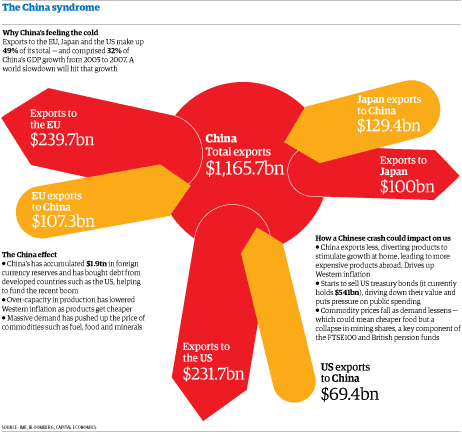
While it is obviously true P.R.C. produces a good amount of the world’s manufactured goods, and a good percentage overall of those are produced not only in P.R.C., but have a history of increasing importance in such places as Singapore, the Pacific island countries, Australia, Japan, T’ai wan, South Korea and the region of Southeast Asia and South Asia – the lot of them.  But what makes P.R.C. so important in its own right, with still its relatively low standard of living outside the urban centers after all these years, as a producer and exporter of goods to the U.S. and Western Europe and other presumably wealthy parts of the world?  While P.R.C. holds maybe a little over a trillion U.S. dollars in the bills, notes and bonds issued by the U.S., it also has a very large population, now much over the billion threshold as reached some time ago.  This means P.R.C. indirectly has financed its economic scale and demographic scope through making the decision some time ago to develop major business and commercial ties with the U.S. – the post – Cold War unipolar superpower.  Also, while for P.R.C. as a country from the Third World bounding over into the First World to the extent it fulfills its political and economic mission of transition from a country emphasizing industrialization and renewed centrism overall, there are a small number of major inputs that contribute to the future economic prospects of the country; not of the P.R.C. administration, but of the economic activity in the country apart from government, including continuing to invest at least some of its current account surplus (not all can do that), conducting more reasonable and goal – oriented what we would call open market operations, increasing the scope of the social net at home, especially for aging workers; getting beyond the fluff of places like Shang hai and Bei jing to manage better its intake of foreign direct investment, and then under the guise of what it calls “Chinese characteristics” and a newer doctrine of its administration under the “Represents”, carrying on the business of actively managing its industrial and commercial base, and then economy overall without the ordinary corruption and parasitism that characterizes some growing economies these days. 

P.R.C. might indeed show a much greater percentage G.N.P. growth than, mention France at this point that might be one percent.  The recent estimates of Chinese economists about the sustained growth over eight or nine percent gross of that country’s economy as a whole does take into account the reports and numbers that are submitted to the center, though it does not quantify the actual numbers of what must be the shadow economy in the country that might be yet another significant source of growth, however illicit, to again enrich those who are merchandising unofficial stoves, televisions, handbags, and other goods and contraband at this point.  In the former soviet union, for example, during glasnost, the shadow economy might have been as great as forty percent of the Russian gross national product at that point, and this gives reason for much of the exclusive and private wealth the oligarchs concentrated to themselves at the time (Boris Yeltsin is criticized for having allowed this and even encouraged it though future studies will probably show this vicious process was a Russian version of hastening the arrival of capitalism in the country.)  The grey economy in P.R.C. at this point might be greater than that in Russia in gross terms because in China right now there are more people who need things, especially the aging worker population, and who have ways of raising the cash out of their life’s savings and so forth to put into the consumer economy – this is and has been a source of unofficial and substantive internal commercial growth for their economy since the time of Deng Xiao ping, and the thinking behind it as it touched upon the issues of young people there could have touched off some of the issues of 1989 that resulted in the administrations reactionary measures at the time.  Rest assured that China’s economy being the way it is, and with room to grow in the area of consumer and durable goods, the grey economy has given the country a somewhat easy and unofficial way to deliver on its economic promises internally over the years.  Time will tell if this and related activities actually enriches anyone and by whom it will be easy to see who the responsible people are for it, be they resellers, middlemen, or some type of ‘oligarch’ as has arisen in their neighbor to the West. 

While the Chinese over the years, not unlike the former U.S.S.R., have chased bad investments in the name of entrepreneurship that sometimes have caused financial and other reorganisations, it is possible that the current limits to growth as a macroeconomic issue will call for less official trade inside the country due to slack in world consumerism and in its financial markets as well.  This will be a good thing for anyone who has a lousy economy and who’s lending things to finance growth, and it might be difficult for example, for France in the next few years to have G.N.P. growth that even equals its inflation rate; so France might want to return to the financial well in P.R.C. consistently as long as China continues to purchase its bonds and export goods there.  Remember that debt is not property nor is it a proxy for property and those in the French “patrimoine” stand in line as stakeholders in any problem with its bonds before the debtholders do.  The rights of debtors and bondholders when in dispute can get quite technical, though it is clear that no matter how much of France’s debt bought by the Chinese, France will always be free of any specious claims on its assets or national treasures due to the character of its own open market operations and its international rights as a debtor.  Outside the P.R.C., international trade rules, and this despite the slackening of some trade at this point in recent reports, maintain the status quo as far as practices and the production of goods and services in exchange for moneys are concerned.  P.R.C. might be greatly concerned by slackening trade as it’s a major producer of goods at this point, but trumpeting the day – to – day problems of this is a way of calling undue attention to oneself, and while there are ups and downs every day, one has to wonder at the same time what the daily figures are highlighted for unless there are some practices driving the trade and commerce from P.R.C. that are questionable.  Ordinary economic systems, capitalism being one of them, have very wisely built in features to absorb the everyday chaos of the marketplace and those angered or upset by ordinary ups and downs might be judged to not being able to see beyond their noses.  These days, so many merchants and traders everywhere are concerned with quick scoring due to an incorrect sensation that’s how money is made these days – by a kind of high – pressure cooker tactics – based business climate.  This is only so true as ordinary people want a basic standard of living, to have a place on the food chain and the like – this is the same in every country with wise leaders or fools alike at the helm.  The current concerns about China as an economic engine that’s slackening are frightful to “Chicken Little” and because most of the world has market – psychology – based trade these days (they count what’s in their pocket books at the end of the day and decide if they’ve fared well or poorly, etc.,) it’s important that daily and monthly indicators (markets and CPI aside, maybe) be given time to return to their general patterns. 

Related Becker – Posner Blog postings on the subject.

Monday, September 23, 2013

Shang hai - symbol of success of the 'three represents' - belated book review.

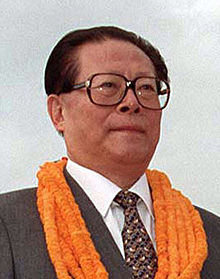
The Man Who Changed China:   The Life and Legacy of Jiang Zemin, by Robert Lawrence Kuhn, Crown Books 2004.

Media Photo
By the “Three Represents”, now in the lexicon of Chinese political thought and part of what the P.R.C. constitution preaches at this point, Jiang Zemin, leader of China during much of the Clinton and Bush years in the U.S., provided for P.R.C. pride and Chinese patriotism in his wording of a renewed emphasis on Marxist – Leninist thought, the dogma of Mao Zedong, and additionally Deng Xiao ping political / economic theory.  While the rise of Shang hai as a provincial and commercial capitol in the P.R.C. was important for that country and coincided with the rise of Mr. Jiang (a former mayor of the city of Shang hai) who became the president of the P.R.C.  These primary principles of political and ideological theory as espoused by Mr. Jiang in practice dealt with agenda items like modernizing the military on the mainland, modernizing political and administrative services processes and practices in P.R.C., and an effort to fight corruption in upholding age – old values of the “rule of law” and a spirit of “virtue” that have a long history in Asia under a Confucian tradition and other traditions on the mainland that recall the great historical legacy and rear view the administration has had after the events of Tian An men in 1989 when Mr. Jiang was a general secretary.  Also included in any implementation of Mr. Jiang’s primary political theory were efforts to reform state – owned enterprises (SOE’s), and revamp the P.R.C. financial sector and rural economy, and the overall increasingly successful effort in itself of the Chinese asserting themselves in the world. 

The commercial and business economy of the P.R.C. as of 1989 was still a “planned” economy, though the agenda items of Mr. Jiang obviously, with their rightist tendencies that had become more admissible at the time, facilitated more market – based activities in the country and in areas of P.R.C. influence politically and economically.  This Mr. Jiang called “advancing through the times”, and I believe my quotes are not out of context here, in validation of the socialist market economy on the mainland, domestic and international, in a kind of “capitalism with Chinese characteristics”.  Mr. Jiang, as a trained social scientist and natural scientist made all personal and professional efforts to revitalize the country primarily through simple re – emphasis and validation, again, of science and education, and this without interfering with the overall workings of the country’s establishment, especially the scientific one there.  This was accomplished somewhat by sending young Chinese scientists to the U.S. to pursue college and university educations (in 2002 over 60,000 students of whom more than 50,000 returned home at the end of their educational terms).  Mr. Jiang, despite being a scientist and engineering type, among the elite in his own state, in his public emphasis upon bringing up the country using his own methods, called for, validated and greatly lauded achievements among the greater populace in carrying out his principles and their practices.  

The time of Mr. Jiang as president of P.R.C. saw pretty much the end of “state means of production” and “dictatorship of the proletariat” as well, though not primarily so, the “each according to his ability and each according to his need” – type civic governance so ridden with vice and corruption as it had been for years on the mainland, and ridden as well with other discouraging tendencies emphasizing the class struggle.  These new principles in practice also meant the end of the overall leviathan power of industrial development and a new primacy recognizing the information age.  In this, Mr. Jiang demonstrated missionary and fanatical zeal, especially concerning the outdated workings of the communist party and how masses of people were treated by the system on the mainland.  These extremely successful efforts, probably the result of many other reforms besides the three basic principles above, and much more administrative and other work than meets the eye here, are reified in what many see today, citizens and tourists alike in P.R.C., as the achievements of the rebuilding, renewal and modernization of the city of Shang hai without interference or any cancelling out of influences of places in P.R.C. like Nan jing, Hong Kong, Guan dong, Bei jing and so forth. 

It is also very important to know that the “Three Represents” comprise not just old and simple ideas as dressed up for modernity.  These principles are communist ideas made to address new concerns of Marxist – Leninist ideology in advancing the productivity, status and dynamism and building up of a material civilization of this managed economy (no longer referred to, for example, as a non – market economy).  The obverse of the Cultural Revolution, intended at the time to discourage intellectuals, these three new edicts call upon innovators, entrepreneurs, and intellectuals now in the vanguard of a “new society” as primary sources for building up the country.  The text goes into considerable detail about how the implementation of these principles worked and much of the language behind them, especially the new de – emphasis of the party role vis – a – vis the masses (primarily industrial workers and farmers), that encompasses the party and the populace on all levels.  Much of this new doctrine was criticized in P.R.C. from the left as ideological ‘pollution’, and as a result was only really established as Mr. Jiang recently left office.  The movement itself is encapsulated in five primary public speeches by Mr. Jiang during the time 1978 – 2001 that illustrated the objectives of controlled political reform while preventing dissension and disagreement, repression and so on, especially again after Tian An men.  Reforms were founded on a basis of enlisting socio – economic stability among the populace and for example, discouraging anti – capitalist (read “anti – U.S.”) attitudes, the greatest good for the greatest number, and a vision of success for all stakeholders – these factors all despite the absence of democracy.  Considering the international public’s view of the success of newly – redeveloped Shang hai and related places, the achievements of the 2008 Olympics, successes in the war against terrorism, and acceptance worldwide of the new dogma; the efforts at reform have been even more successful with the country’s communist party that while it now cannot control everything allows some small non – communist political activities and party organisations, cooperation of non – communists and NGO’s with the party, and the new rise of the C.P.C. as a model guarantor of the state’s integrity, leadership strength and other attributes, Chinese nationalism, and new Marxist thought of which former soviet influences and followings.  The three principles are said to have modernized the party, economics of the country, while retaining the traditional communist goals, structures and social rules that have been in place for more than a generation. 

This was brought about by an emphasis upon youth and renewal, and new colleagial and consensus – building administrative guidelines.  Those carrying out these efforts have presumably been part of the “inner party” of educated, talented, and sophisticated, dedicated elite acting against corruption and with a transitory character according to the modern realities of communism.  With the legacy of Deng Xiao ping theory it has been very difficult to assure or re – establish social stability after the events of 1989, though Mr. Jiang is said to have provided the country with consistent reform efforts featuring his executive, engineering and leadership qualities:  For Mr. Jiang, if you will, a sort of combination or cross between Beethoven and Shakespeare.  Things might nonetheless have been like the old Phoenix Cardinals playing the Houston Oilers in the day, but this series of coup reforms by Mr. Jiang was quite successful and extremely popular at the same time as based on intellectual and patriotic ideas and the power of same in efforts as well to dispel income disparities, master world macro – economics and inflation and fight corruption, over – taxation and unemployment.  The language used in the book mirrors the language about economics in the Western press and speaks authoritatively thereby, and by this calling for the old adage “trust but find fairness in it.”  The text proceeds to illustrate how the new principles and processes worked, and goes on and on about much of it while richly illustrating the story of Mr. Jiang including a good section of chapters on early life and political formation.  And that’s not all.    

2013 Blog Article - Wall Street Journal.

re - edited 09/28/2013.

Wednesday, April 11, 2012

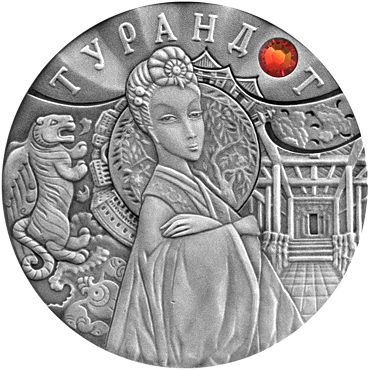
Why don't you just stick to "Turandot," the food and drink, and so on?

Media Photo
With all that is being taught about the P.R.C. lately in schools, and with the books that have appeared about its style of capitalism as state - sponsored with heavy emphasis placed upon labour productivity and discipline, we as Americans and westerners might take a different approach to P.R.C. and its current role in the world, even as the second most powerful world economy, and without respect to revisionism.  Once one reads about the "Great Leap Forward," "Hundred Flowers," "Cultural Revolution," "Gang of Four," and even stories about the beginning of the last century in places like Bei jing and Shang hai and the role of these and other places, including Nan jing, up through and including the Chinese revolution that ended with the founding of the P.R.C. in 1949; it is impossible to skip over the way this nation treats its own people and the way it presents them to the public here in the West.  We could take a lesson from the former soviets on how to deal with our own commercial and business self - interest and the Chinese in reminding them of some of their bureaucratic shortcomings resulting in lives pilloried and wasted, many of them in building the society in China today as restrictive and productive as it apparently is as compared to the western world.

It might be possible, and this without professing a moral higher ground, with regard to the P.R.C.'s current market power and growing military and public financial interests and insinuations, to appreciate the culture of P.R.C. (not T'ai wan) as having led up to this for a long time, even from before pre - revolutionary days.  One comparison one might make between mainland China of old and today starts with the T'ai pings who can be likened to communist conservatives who showed a kind of Christianism in their belief system, however distorted that vision of Christ was.  The Chinese communists of today with their apparent assimilation of western methods and commercial ideas and practices appear as somewhat palatable followers of western methods, and agnostic at the most (again seemingly) with respect to their attitudes about western people that actually range from extreme xenophobia to ordinary Orientalism.  This is similar to the use of western ideas used by the T'ai pings to try to take over the country during the mid - 1800's, provoking a bloody civil war that threw a good part of the provinces and Bei jing back politically and commercially quite a ways, given the status of Hong Kong, Shang hai and other places, including the capitol after the civil war there had ended.

Media Photo
It is entirely possible the primacy, however implied by commercial statistics and business methods and rules to date as developed by the Chinese for their own purposes, of the P.R.C. at this point should be called upon to fall back on its laurels of Oriental culture, arts and hospitality, including the overall national emphasis on social interactions and festivities and holidays.  What might prompt this?  When was the last time you valued a product as "Made in China" for anything other than its strictly financial economy?  Without respect to public finances that are needed by its satellites in Asia and the role P.R.C. currently plays in public finance, that country should continue to try defying its role in the world as a rich copy cat, for example, among others, but at the same time need accept that its style of economy pretends to and bears and depends upon being a witness to the detriment of the Occidental powers.  This is in the doctrine of its core ideology and the pronouncements of the country's founders, not so long passed, in Mao T'se toung and Zhou En lai, and others sacrificed on the internal hecatomb of that country starting with its, again internal uprisings at the end of the Qing dynasty.  In exemplary mainland Chinese fashion, the current leadership has made all attempts to get away from this through doubling and redoubling financial and commercial efforts as managed, and as expanding the political and military outreach of the country in a kind of indirect belligerency against all its liberals.  With respect to the legacy of the past, the political role of P.R.C. and its satellites at this point needs be re - examined with respect to the overall legitimacy of its demanding role in world affairs (as the "Crouching Tiger, ... .")

Sunday, November 20, 2011

How Is The Yuan Doing (even in China Proper)?


There is no specific identity that shows the Renminbi is undervalued, but there are signs of this, including that the economic leadership of that country, especially the central bank, has worked to keep GNP growth ahead of inflation.  That economically healthy countries do this is a sign of good business and serves as a powerful attraction for investment moneys, tourism, trade and internal commerce.  The last time, for instance, many of the older, established western countries enjoyed this type of commercial growth was long ago, and the effect was simply blamed on the idea that these countries had colonies, slaves, and so forth.  The fact is that western countries woke up to different issues about 100 or so years ago, and realized that economic statistics and figures, even unemployment statistics are of secondary importance to other socio - economic issues, like productivity, capital flows, the number of cars on the road, alcohol statistics, the problem with crime, and so forth.  P.R.C. in toto has not begun to deal with these issues on a public policy level, especially given the high rate of suicides among the populace, the place of women and children in that society, and so forth.

So what arithmetic or geometric identity will tell whether or not the P.R.C. currency is undervalued?  There isn't one, but there was some time ago, a similar problem with the Japanese Yen having a low value against the dollar (say during the 1960's - 70's.)  I have not checked the latest value of the Yen since it reached around 100 to the U.S. Dollar some time ago (another overvalued currency.)  The solution to the Yen value at the time was a transitional mechanism, much is like what the Chinese have agreed to at this point, but that mechanism is old and subject to subtrefuge as the Yen mechanism was.

One alternative to the current standard that measures the Renminbi instead of using the U.S. Dollar is to peg the Chinese currency to gold, but at that juncture the Chinese will try to buy all the gold they can with their Dollar reserves and that's not good, either.  Another alternative would be to slap the P.R.C. with trade sanctions until it allows its supported currency to float freely.  This would interfere with attempts by domestic Chinese policy makers to improve the lot of their people while they are in a position to do so.  The question is, do we as holders of U.S. Dollars and Dollar assets, care about our Chinese neighbors enough to want to let them build their country at significant expense to us.  This brings up an entire series of questions, including things like technology and human resources "transfers" to P.R.C. that are actually government and corporate gifts to satisfy unhappy people in their leadership (people like me some times use the term 'spoiled' to describe this sort of character.)  Further, in addition to the merchandise that is produced in China and that we spend so much money on, how can we quantify the disinvestment and 'brain drain,' and technology exports, some of them clandestine and carried out by cheaters in the system?  Policy - makers everywhere who hold U.S. Dollars can not quantify these and other factors that will contribute to a real valuation of the Renminbi.

People like me know that it is indeed difficult to revalue a currency that is sponsored or supported by major bank operations, and not just those of the Bank of China (and I mention this without reference to any specific, sovereign nation or financial institution,) and that same of a state - controlled, essentially non - market economy that has grown very large and powerful.  Without mentioning the nature of the dangers of non - market systems to capitalism and so forth, it is obvious that China produces many goods without respect to purchasing power parity and other factors within the country of China and maybe even within Asia as a region.  This is what is so dangerous, when the leadership of a sovereign nation represses things like needs and wants of its people, even major needs and wants such as happiness, freedoms, success and so forth; about command economies which P.R.C. in fact still is at this point.  The reasons why are complicated, especially the long - term consequences for trade and capital flows, but people like me again do believe this current course of events could provoke a crisis, and in order to avoid a crisis, P.R.C. should be called upon to re - value its domestic currency, and the order of business is that eventually the role of the state in business, if it is as China declares it to be - an agent to assure economic and investment success - will eventually become less conniving and of secondary importance to the real creation of value and wealth in P.R.C. itself.  There is by analysis in China today a kind of 'will - to - power' economically and politically in the world, and in other domains such as science and culture, and it is important to mention there is nothing that will assure the growth of any intrinsic value of that country apart from its historical role and reputation, even within Asia, given the machinations of its policy makers today and how that translates into an artificially low value for its trading currency.  Investment possibilities, in fact investment yields, and other measures of business success in other parts of the world and the history of same; and their continued success have made the Chinese kind of angry and envious at foreigners, and this despite some very meritorious things the Chinese people represent.

This said, the Renminbi is without question undervalued, but by how much?  The fact is, everyone, including the man in the street has their own ideas, but in fact people like me know China has used its debtor accounts and other accounts to influence purchasing power parity, interest rates, and investment yields everywhere it sells products, some of which are very good.  That this should stop is a question that the P.R.C. leadership sees as debatable, including the effect all this has had on its currency that is as much as 60 % undervalued given various factors, and maybe more.  Simple quantitative analysis of Dollar reserves, current account balances, capital flows, interest rates, and other numerous private information might yield a similar answer, but remember as well that psychological factors and other influences in the currency markets might call for a further devaluation of the Renminbi, and this remains to be seen.  Despite what any reader of this article might believe, what is written here is not specifically a response to U.S. international Dollar values are, because I do not know them at this point.  This writing is, however, a response to Chinese economics, apparently as developed in Shang hai years ago and then distributed everywhere (same, for instance, as the 'Hundred Flowers' under Mao, but with practices that have been more dominant and more successful despite questions about their legitimacy as have come out in arguments about currency values,) and on and on.