Showing posts with label politics. Show all posts

Wednesday, April 11, 2012

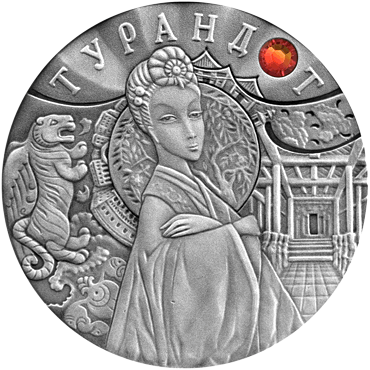
Why don't you just stick to "Turandot," the food and drink, and so on?

Media Photo
With all that is being taught about the P.R.C. lately in schools, and with the books that have appeared about its style of capitalism as state - sponsored with heavy emphasis placed upon labour productivity and discipline, we as Americans and westerners might take a different approach to P.R.C. and its current role in the world, even as the second most powerful world economy, and without respect to revisionism.  Once one reads about the "Great Leap Forward," "Hundred Flowers," "Cultural Revolution," "Gang of Four," and even stories about the beginning of the last century in places like Bei jing and Shang hai and the role of these and other places, including Nan jing, up through and including the Chinese revolution that ended with the founding of the P.R.C. in 1949; it is impossible to skip over the way this nation treats its own people and the way it presents them to the public here in the West.  We could take a lesson from the former soviets on how to deal with our own commercial and business self - interest and the Chinese in reminding them of some of their bureaucratic shortcomings resulting in lives pilloried and wasted, many of them in building the society in China today as restrictive and productive as it apparently is as compared to the western world.

It might be possible, and this without professing a moral higher ground, with regard to the P.R.C.'s current market power and growing military and public financial interests and insinuations, to appreciate the culture of P.R.C. (not T'ai wan) as having led up to this for a long time, even from before pre - revolutionary days.  One comparison one might make between mainland China of old and today starts with the T'ai pings who can be likened to communist conservatives who showed a kind of Christianism in their belief system, however distorted that vision of Christ was.  The Chinese communists of today with their apparent assimilation of western methods and commercial ideas and practices appear as somewhat palatable followers of western methods, and agnostic at the most (again seemingly) with respect to their attitudes about western people that actually range from extreme xenophobia to ordinary Orientalism.  This is similar to the use of western ideas used by the T'ai pings to try to take over the country during the mid - 1800's, provoking a bloody civil war that threw a good part of the provinces and Bei jing back politically and commercially quite a ways, given the status of Hong Kong, Shang hai and other places, including the capitol after the civil war there had ended.

Media Photo
It is entirely possible the primacy, however implied by commercial statistics and business methods and rules to date as developed by the Chinese for their own purposes, of the P.R.C. at this point should be called upon to fall back on its laurels of Oriental culture, arts and hospitality, including the overall national emphasis on social interactions and festivities and holidays.  What might prompt this?  When was the last time you valued a product as "Made in China" for anything other than its strictly financial economy?  Without respect to public finances that are needed by its satellites in Asia and the role P.R.C. currently plays in public finance, that country should continue to try defying its role in the world as a rich copy cat, for example, among others, but at the same time need accept that its style of economy pretends to and bears and depends upon being a witness to the detriment of the Occidental powers.  This is in the doctrine of its core ideology and the pronouncements of the country's founders, not so long passed, in Mao T'se toung and Zhou En lai, and others sacrificed on the internal hecatomb of that country starting with its, again internal uprisings at the end of the Qing dynasty.  In exemplary mainland Chinese fashion, the current leadership has made all attempts to get away from this through doubling and redoubling financial and commercial efforts as managed, and as expanding the political and military outreach of the country in a kind of indirect belligerency against all its liberals.  With respect to the legacy of the past, the political role of P.R.C. and its satellites at this point needs be re - examined with respect to the overall legitimacy of its demanding role in world affairs (as the "Crouching Tiger, ... .")
Monday, December 6, 2010

Another, belated review of "America and the World," by ...


This political book, written with David Ignatius examines current affairs and gives a new detailed synopsis of the role of the U.S. in the world, primarily from the time of the Marshall Plan through the Cold War and related nuclear threats, up to the fall of the former soviet union and then through 9 / 11 and beyond.  The text presents the idea that modern life, especially that in western society is in a new form of complexity not even seen since the fully bureaucratic days of Byzantium, for example.  The book begins with its proposals about historical events and their significance to us at this point (now 2008,) and then moves on to examine various questions, such as the Israelis and Palestinians and their state of affairs vis – a – vis the prosecution of the Iraq war.  With respect to Israel, there are great influences calling for a resolution of the conflict with the Palestinians, even at great sacrifice to the Jews, and this is in part what here is interpreted more and more as a ‘status quo’ to begin resolving this and other Middle East issues.  In fact, to abandon the ideals of an Israeli homeland at this point in time would be to equally abandon important U.S. state policies and roles in associations like the G – 20, N.A.T.O., our positions on nuclear non – proliferation and Eastern Europe, in favour of the polity of states like Iran who essentially exploit anti – Israeli groups like Hezbollah and Hamas.  Some of the text is dedicated to illustrating the last part of the Bush Administration and efforts to resolve the conflicts of Hamas, Beirut, and the role of Syria against the Jews, though this effort was shown as, and in fact was not overridingly successful.

The Taliban are perceived in the theme of this examination of historical events through Brzezinski and Scowcroft as a significant threat to U.S. national security, and as the memorable opponents of the soviets in Afghanistan as well.  One is also reminded the Pakistanis and the Taliban were trained by western military people, again against the soviets and the situation as it is today with the Taliban is extremely rancorous with respect to western governments.  

With respect to economics, though mostly politics in the Far East, the authors illustrate principally the rising power, economic and political, financial and so on, of the P.R.C. in terms of the enlightened self – interest not only of its Asian neighbors, but of western officialdom as well.  The rivalry between the P.R.C. and its Asian contemporaries with the west is nonetheless portrayed as ruthless in economic terms.  The issues of Tibet and T’ai wan, and South Korea are easily interpreted as very tense situations with P.R.C., a communist – party based government still dealing with the legacy of T’ian An Men and Deng Xiao Ping; and the recognitions of the legitimacy of smaller Asian associations such as A.S.E.A.N.  Special mention is made of North Korea and the need for its own adherence to nuclear anti – proliferation rules and other regional security issues including the naval incidents of late.  

Special mention is also made in large part of Russia and its current leadership after the very significant Gorbachev and Yeltsin years:  Apart from the conundrum surrounding the mutual political and administrative status of Dmitri Medvedev and Vladimir Putin, there seem to be four major issues with Russia, and all are unsolvable:  Nuclear non – proliferation, N.A.T.O. and the former soviet and COMECON (and Warsaw Pact) states, the vagaries of the petrol business, and relations with P.R.C.  With respect to Eastern Europe, still, Western Europe is illustrated as at times a fitful ally and then again as a close political and administrative partner that is attempting on the state level to rise above issues of nationalism in its institutions.  It is here where the authors bring in their partitioned time – lines on American politics and the world, dating back to the age of John Quincy Adams, then forward to the Wilson presidency, and then post – 9 / 11 events.  Brzezinski notes at this point the older European community was much more cohesive on a regional level given the two devastating world wars and the Cold War during the 20th century, and needs at present better political coordination.  With respect to World Wars I and II, N.A.T.O. is still an issue unto itself that affects the sovereignty of most Europeans, regardless of nationality or where they reside in the region.

To begin the conclusion of the text, the authors enter into a discussion about the importance of human dignity and human rights, and its influence on their ideas about doctrinaire enlightened or “guileful” realism in affairs.  There is also some discussion of a new world order in which cultural identities have primacy, hearkening to the world of 20th century Wilsonian political ideas.  The new administration in Washington, D.C., while it promised a number of important things, especially about changes in government, is seen currently as bogged down in its own efforts, and with respect to foreign policy there has been progress and reform in the integration of departments and agencies as far as communications and functioning are concerned.