Tuesday, July 17, 2012

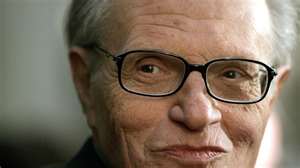
Larry King NOW

Media Photo
During the early 1990's, a good friend of mine at the time suggested I listen locally to a national radio station at the six o'clock hour (commute time) - the "Larry King Live" radio show as it was apparently known then.  I was in school and subscribed to a local paper for news and knew of the show, but never really became a fan until Mr. King's show rose in the television rankings.  At the time I was introduced to the radio broadcast, the show was actually on televison twice at night, but I did not have cable and was watching a Los Angeles network television talk show at the time as sponsored by Paramount (at the time excellent programming as well.)  People like me know everybody has watched and talked about "Larry King Live" over the years and the guy has millions of fans:  So why not an internet television show at this point for the biggest cable talk show personality at this point (and possibly the biggest talk show personality ever, even as compared to network talk show personalities past and present.)  See Larry King's internet talk show, "Larry King Now" on Ora.tv, another innovation from the genius, or at least the legend of radio / television talk.  It does appear you need to have the bandwidth to watch the show - and have a high - speed connection if you plan to take in this program.

Also, see HULU and Jimmy Kimmel with Larry King.

Saturday, July 14, 2012

Linked to Jackson - Vanik ...

...  another trade bill (read on) with ...

In This Interconnected World (belated book review.)

Media Photo
The Geopolitics of Emotion, (Dominique Moïsi, 2008, Doubleday.)

In this long essay that ends with a chapter on futurology, the author makes an attempt to replace the old paradigm of simple political nationalism with one that is psychologically – based upon political confidence, identity and emotions (primarily fear, hope and humiliation among those.)  In this increasingly interconnected world, the three emotions providing a sketch of the collective conscious and unconscious outside the ordinary mapping of economic and other resources.  This level of analysis of current events and trends in its subjective orientation might help the reader to recognize different patterns of change in the world outside the everyday models we all read, watch and hear about.  The primary examination in the text is that of the weight of Occidental Europe and American on other states, primarily in the areas of politics, economics, administration and business; and the concerns of other states over other places including Latin America, Russia, Turkey and Ukraine.  This theme of overall anxiety about what is going to happen with these territories and others in view of a rise in political and economic power on the Asian continent, of which principally Singapore the P.R.C., and the antithetical political / economic climate in the Southern Hemisphere now mostly in abject poverty, comprise a good part of the author’s writing that makes up the book.  Some discussion is made of Germany and its new role in world affairs after reunification, though the author pays more than lip service to Central Europe that has become again a territory with an increasing global stature, and with the agreement of many nations.  That the author is a child of a Holocaust survivor and devotes some attention to this and similar happenings is a talking point as well.  These overall themes are cause for political discussion everywhere and they set up the rest of the issues examined in the book around a background of international concern and anxiety over what are now some apparently average – educated, yet growing and more and more influential ideological radicals.  

The book faithfully describes the great improvements and increasing might and hopeful circumstances of Asian countries after a long reorganization and many fits and starts:  There are apparently several commercial centers on the Asian continent outside Shang hai, that are comprised of, again, Singapore, Mumbai, Dubai, and others.  The realization of their fortunes in the kind of real estate projects in these places give hope to those in poverty in these places that are similarly and unfortunately also targets for terrorism.  All this development, even in Japan where the country itself is quite Europeanized (though at this point ‘downhearted,’) has resulted in less antagonism toward Europe and America; and as a result of all this and despite world terrorist groups, the world is a less dangerous place in many respects at present.  China and India, as a consequence of their reorganization and modernization policies have many demographic issues and difficulties to deal with now and into the future. 

There are observably within the authors’ scope in this text conditions for despair in places like Arabia and Africa where terrorism, cited often as Al Q’aeda terrorism, attempts to deal with ideological conflicts with the European continent and America, and threats of a decline of Islam and Arabic influences everywhere.  Quite observable again in this mesh of issues is that of Israel, as from fitful to increasingly vulnerable in view of increasing frustrations in the Arab world about the existence and continuance of that country despite the promises of its neighbors.  Additional frustration and anger over Israel is caused among the Arabic people on the subject of the long – past fate of the Ottomans, and even the toppling of Mossadegh (1953) in Iran that provoke even more detailed discussion and contention, that are relied upon and that might at this time be better relegated to various histories and chronicles.  It is clear to some the Islamists in Arabia would prefer an Islamic and not a Christianized Europe (cited here is “Globalized Islam,” a recent report by Olivier Roy.)  This is frightening to some given for instance the Muslim attitude towards women and women’s rights and autonomy.  The dogma of Islamist terrorism as espoused by Al Q’aeda, despite its proponents being so well – educated and as appealing to the intelligentsia in many places, finds a home more likely with the extremely poor and dispossessed in places who are searching for ways to humiliate the West and its countrymen.  The links between terrorism and Islam, violence and Al Q’aeda, must be separated from each other at the source and in the eyes of the public in order to do away with the Arab emotions that aid and abet terrorism, notably the anger, fear, boredom, apathy, depression and aggression that pervade Islam.  Breaking this / these link(s) would provide a way to change the “Arab – Islamic culture of humiliation,” as the author says, away from the dogmatic and rhetorical diatribes against Occidental interests and their people, and against the kind of volitional and gratuitous violence in the news everyday as originating in Arab capitols.  Again, the book ends with an essay about the future and geopolitics that is as well worth reading as the rest of the text.  

Wednesday, July 4, 2012

2012 Movies - Oliver Stone And Tax Policy (... and maybe even the oil business.)

Media Photo
That I know people like me have never really seen an Oliver Stone movie in the right light (if we have seen one,) mostly because we were too young to comprehend the kind of metaphysics and mysticism that goes into even the most mundane of Stone’s ideas as realized through film, but why make another film about characters as influenced by the counterculture with again a message about right – wing conspiracies, the government, the university system, pot and relationships, the black market for drugs, all of which are ideas used by Mr. Stone to stir our attention to his cosmopolite and quite detailed and complicated view of things?  Mr. Stone, and to his credit, was born into a background in which he resisted the temptations of the vices and other wrongs he illustrates in his productions, even the moral and other character defects of the related roles in the scripts he imbeds on film – you do need to be a “clean” person these days to succeed in the entertainment or media industries.  As well that Mr. Stone fought in a bitter military conflict, and probably blindly as many men did at the time, that was at least in part dedicated to eradicate the illegal streets drugs market as we knew it during the 1960’s and thereafter; a conflict the U.S. officially abandoned, also adds to his illustration of the colorful and sordid as an authority on these who maintains in fact a critical and necessary distance from societal problems and vulnerabilities, and as such one might observe a contrasting reality between the character of an artist and the media he produces.  This trait or set of traits might also be entirely necessary in the oversimplified yet Hegelian world in which he finds himself, and similarly that of his characters, bright and educated and at the same time illicit as many of them are:  But why make a film about pot?

To know the answer to this question for Mr. Stone, as probably no one does, has to do again with the iconic mysticism of many of his productions and the very salient and high – profile themes he decides to address in his movies and interviews, etc., probably even in his relationships with his acting and other film crews.  To illustrate this, try to picture Mr. Stone as a director of a “Barney The Purple Dinosaur” media production, or a “Clifford” the dog feature.  This is impossible and improbable and might even be the subject of humor at his table when he and his major motion picture people talk about it.  The themes he examines, even in the sort of action / drama / mystery films he directs, are even more glaring than the stifling red lights at busy traffic stops during the height of rush hour, or even more attention – getting than having someone shouting in one’s ear(s.)  The issues of Mr. Stone’s productions are also problematical and propose in many instances an incomplete story to his viewers; all of this done with a goal of stirring the moviegoers’ minds out of any torpor or boredom (doldrums) that adds up to modern malaise.  The scope of many of his themes is so important with respect to American society and its issues at this point that one can hardly overlook the object lessons and teaching element in his films, at least insofar as how the movies are viewed today.  It is also something to be wary of and for example to look at a second time in the director’s overall efforts at political and cultural persuasion and in the high impact of much of what he presents that trumps even existential themes themselves sometimes.  That he has chosen to examine dramatically the culture of a simple street drug, as pervasive and insidious as it is, mirrors probably much again the ethical and practical morality he learned as a young person, at Eastern colleges, in national service and then in film school.  His relationship to the work of his mentor, Martin Scorsese, with respect to his continued filmography does indeed show a mirroring of attitudinal, moral, intellectual and other influences upon the man that contrast with who he actually is in his films.  This might be why he has succeeded for so many years in Hollywood as a town full of pitfalls, and as a place probably worse than any capitol as far as “sink or swim” is concerned. 

It does not really matter in and of itself that Mr. Stone has made a movie again about educated people who out of Adlerian and other difficulties do odd things, even blatantly illegal things.  His films going back some ways are probably full of such characters and their illustrated roles.  What does matter is the overall weight of Mr. Stone’s ideas that call for an examination of conscience through his telling of stories in film.  Though I have never really seen his work, maybe only part of one of his war movies, the overall questions provoked by his work and the inclusiveness with which he creates his things for people to experience are remarkably noteworthy.  Maybe all young people need to see at least part of this new movie, “Savages” (book by Don Winslow,) as directed by Mr. Stone, that apparently examines the “party” atmosphere of pot, not from a cult point of view but from its utilitarian and economic consequences; and this might change a popular attitude (or two) about it.  This writing is neither a movie review as admittedly I have not seen “Savages,” and nor is it a review of Mr. Stone’s directing abilities or acumen for better or otherwise.  These few paragraphs do however propose the meritorious courage of a Hollywood person examining social and societal forces that are age – old.  Remember finally that the streets drugs trade is a trade interdicted by state authorities (on every level,) and as the subject of this film should also be looked at in terms of its message and the government expenditures (funded by taxes) in eradicating pot and its related markets.  Mr. Stone might have a phrase or two in his film production here referring to this without allusion for one to the idea that the state has an attitude itself of persecution with respect to streets drugs and their markets. 


Tuesday, June 19, 2012

The Sorcerer's Apprentice.

Media Photo
While the current approach to political relations with Russia at Cabo San Lucas as described by American Ambassador Michael McFaul is appropriately "businesslike," and cordial; it is important to observe, or re – discover one overall issue that presents itself with any assertive if not aggressive Russian regime at this point.  There is a huge overhang in Russian society to date of the “class of 1937,” as this legacy, political, administrative, cultural and scientific does determine and visibly affect the modern polity of the Russian Federation in many ways, internal and external (see article from “The Economist” magazine,) especially with respect to the utility of and gainful aims of a now  understated leftist / authoritarian Russian regime at this point.  In typical fashion, and without regard to the seriousness of it, the Russian regime itself has gratuitously accepted and begun to abuse its status as a WTO (nothing to do with Warsaw, for example,) member at this time.  One might find numerous examples of late of the Russian Federation “scoring” in international trade as the result of its newly – won trade status, hardly a reason or reasons to have others take notice of this harmonious trade organization.  The article from “The Economist” also suggests Russian candidacy for the O.E.C.D., and this seems likely only in the event there are many again Russian sympathisers within that Western cooperation and development organization at this point as well.  There have indeed been for years, and as such a consideration as far as Russia is concerned only calls for further confusion about global economic issues and the emphasis in Eastern Europe on “heavy” industrial economics and its supposedly enticing appetite for financial windfalls and profiteering (even in the distant past under the soviets.)  The magazine article cited here also appropriately calls for a stoppage of the arms business going on with Syria in view of the war there, something the Russians have been notorious over their relations with the Middle East for years starting in the 1960’s – and no one is likely to bully them out of it anytime soon. 

That all of this should add up to more cessions to the Russian Federation does not really add up at all, despite the efforts of some to balance the arguments and discussion about what needs to happen with Russia and trade, politics, human rights  and so on.  Human rights remains an opaque and unresolved issue in that country and a subject of hot contention and debate among commentators everywhere people are allowed to have free discussion; including in places like Seattle, the source of the Jackson – Vanik legislation from years ago that in its own understated way maintains linkage between civil, political, civic, human, administrative and other freedoms in Russia with its international status and recognition by the great powers.  The questions about ushering in a new foreign policy on Russia (in repealing by the one, Jackson – Vanik and other measures) and allowing it to continue its leviathan centrist ways along Hegelian lines, essentially without respect from its  administration as to its own internal debates, even as they are proposed in places like Cabo do indicate a kind of economic ‘playing with fire’ the great powers are doing at present in view of the overall inadmissible tone of that federation’s leadership at this point.  This is indeed observable in the meetings between heads of state at the latest G20, especially in what concerns its puffing itself up economically and its adversarial posture to even its near neighbors in Eastern Europe, not to mention its supposed overseas trading and administrative partners including now the U.S., U.K., France and others.

See also, "New York Times" article.

Sunday, June 3, 2012

After Hearing about The Romney Economic Policy.

Media Photo
Mr. Glen Hubbard, obviously a Ph.D., was on the television today at CNN in the role of Mr. Romney’s chief economic advisor or spokesman at this point.  Several salient issues arose during his talk with the blogger / commentator Mr. Zakaria including the deficit and insurance woes that have been badgering candidates for a long time, including Mr. Obama, the current U.S. president.  Mr. Hubbard, in speaking about the budget issues delivered an excellent essay on the difficulties of carrying on as the society with the most civic, political and other freedoms anywhere, and his presentation appeared to be a kind of “you don’t get something for nothing” type trial balloon.  Sometimes indeed in the process of electing officials, the voters can be handed, and for various reasons, nothing for something, in which case there is much negative clamouring and scandal.  It does appear from his spokesman the Romney campaign wants to work out its promises to the American people without being unrealistic.  These were some of the issues Mr. Hubbard fielded this morning, and without claiming to analyze whatsoever the process of lightening the budget load, his explanation turned on revenue collection or spending reductions.  Depending upon what the people want, the candidate appears to be listening to how people want to approach austerity measures:  Through “cutbacks,” “budget controls,” “constraints,” and the like, or “new revenue,” and / or revenue collection.  The actual plan might be a combination of both, which would do something to eliminate widespread use of loopholes and weak points in both budgeting and tax policy.  The substance of the interview consisted of Mr. Hubbard presenting this, but not necessarily presenting anything beyond overall policy definitions, and the viewer was left with likes or dislikes as the case might be, along with policy and party choice as well. 

There is another issue, and that is unless any budgetary policy or tax policy is successful, mostly as a surprise or some overriding spontaneity, what will the U.S. populace do given the risk to public finances upon even at first the examination of policies as successes or failures?  There’s no answer to this, and while in the olden days, one Republican president instituted wage and price controls to accomplish monetary and fiscal goals alike, and this under a policy that was publicly unfavourable, it does appear such unusual approaches to the budget and trade, and the federal revenue issue, need be considered.  The wage and price controls were a palliative, but woke up a lot of people to attention about where the public finances of the U.S. were headed at the time.  By this writing, the author can not mention the advantage of budgetary controls over tax reform, nor vice versa, though these are not exclusive and maybe some policy – maker could determine some arithmetic identity without the present and ubiquitous gallows humour on these topics, and that would give any federal administration some hope of having an actual fiscal / monetary goal to accomplish apart from the abysmal picture some economists paint of public affairs and money these days.  That any such goal would be attainable in terms of federal finances will remain to be seen, and there are many pessimists about the current, related metrics as recorded, not to mention the prospective ones.  Austerity measures were mentioned in the talk on television today, and all forbid the U.S. having a reaction to austerity policies, either formally at election time or in the street, if they are indeed needed at this time.

Another topic at the talk with Fareed Zakaria was national health insurance and the compulsory provisions of this policy concerning coverage, and for which the president is being sued by the Catholic Church given certain provisions.  People like me know that the actual insurance problem as it is approached by policy – makers is quite intractable as there is only so much insurance that can go around.  People believe that their insurance is a kind of financial instrument at times and treat health insurance exploitatively as such on many occasions, and this is a sin.  Health insurance has to be paid for, unfortunately for everyone, and this financial issue and the role of health care in the U.S. economy really make such issues the subject of extreme opinions and educated and technical debates and discussions alike.  The idea of the Massachusetts health care system was discussed as portable to the entire country, and Mr. Hubbard suggested it is not – indeed the demographics (an important health care parameter, even determinative of actuarial and other aspects of insurance plans) of a state like Massachusetts are obviously dissimilar to those of West Virginia or Florida; and one can not bolt a standard from a Massachusetts public health plan onto California or Idaho, either.  This is what makes solutions to such issues incredibly difficult and the subject of adversities, including economic and social ones, business and cultural, etc.  One idea that has not been greatly discussed, at least not publicly, is a national public health system as an auxiliary to private care with pay – as – you – go and / or insurance coverage itself with a deductible or co – payment.  Such a system could be self – financing and profitable for the government and would stratify, equalize and reduce the financial burden of any federal system.  MediCare for older U.S. citizens is an example of such a system as weighted towards federal oversight, though any new system might be a health care / maintenance auxiliary to private insurance concerns.  By this writing, the author is surprised this was not discussed with regard to either the Massachusetts plan or the required health insurance as currently promoted by the president.  Without sounding litigious, Catholics because they have values accruing to very technical issues about women’s rights, women’s right to choose and decide, and abortion itself, and other issues that would be addressed by an umbrella federal health plan, do have, and I mention informally here, an argument with the law.  Catholic bishops and perhaps even the pope would do well to provide some decisive guidance here, and as of yet I have heard none.  Also, and as an endnote, neither Zakaria nor Hubbard brought up any economics argument or policy about what to do with trade.  This probably means both parties are in agreement about some policy as already implemented and will not contest each other on these grounds so far (maybe both main presidential candidates admire and accept the current status quo on trade and will just discuss this secondarily in any debate.)  The trade issue as examined by anyone at this point has to do with long – term labour productivity and benefits and the level they are at today.  Developed and developing economies that apparently have more productive labour forces also have less history in them on contests for higher wages and management changes in the modern sense.  This is why the so – called productivity statistics could be questioned – other countries are less in – touch with modernity than the U.S. is at this point (hush,) and any focusing on the labour market only in economic policies in Western economies causes things like prices, interest rates, bank and other rates, including growth rates and productivity measures themselves to first gather and then integrate improper bias that skews and could ruin business – this would be uncalled – for under the circumstances.

Please pardon typhographical errors.  THS 
(an admirable time ...) ... without swearing allegiance.


Media Photo


Media Photo


THS